
Van Gogh flower paintings range from crowded Paris bouquets to the spare blue background of Almond Blossom. They were not created as one continuous series, and they do not all carry the same symbolic meaning. In Paris, Vincent van Gogh used flowers to test new color combinations. In Arles, sunflowers became part of his plan for the Yellow House. During his final year in Saint-Rémy, irises, roses and flowering branches gave him subjects he could study close to where he was staying.
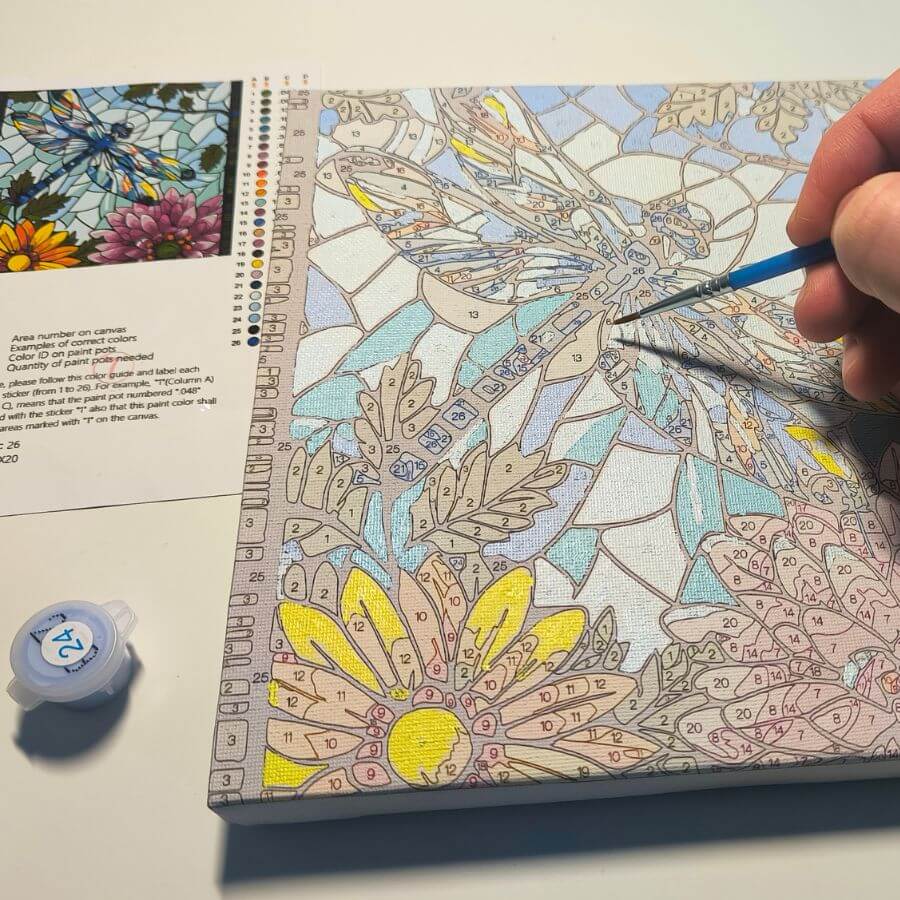
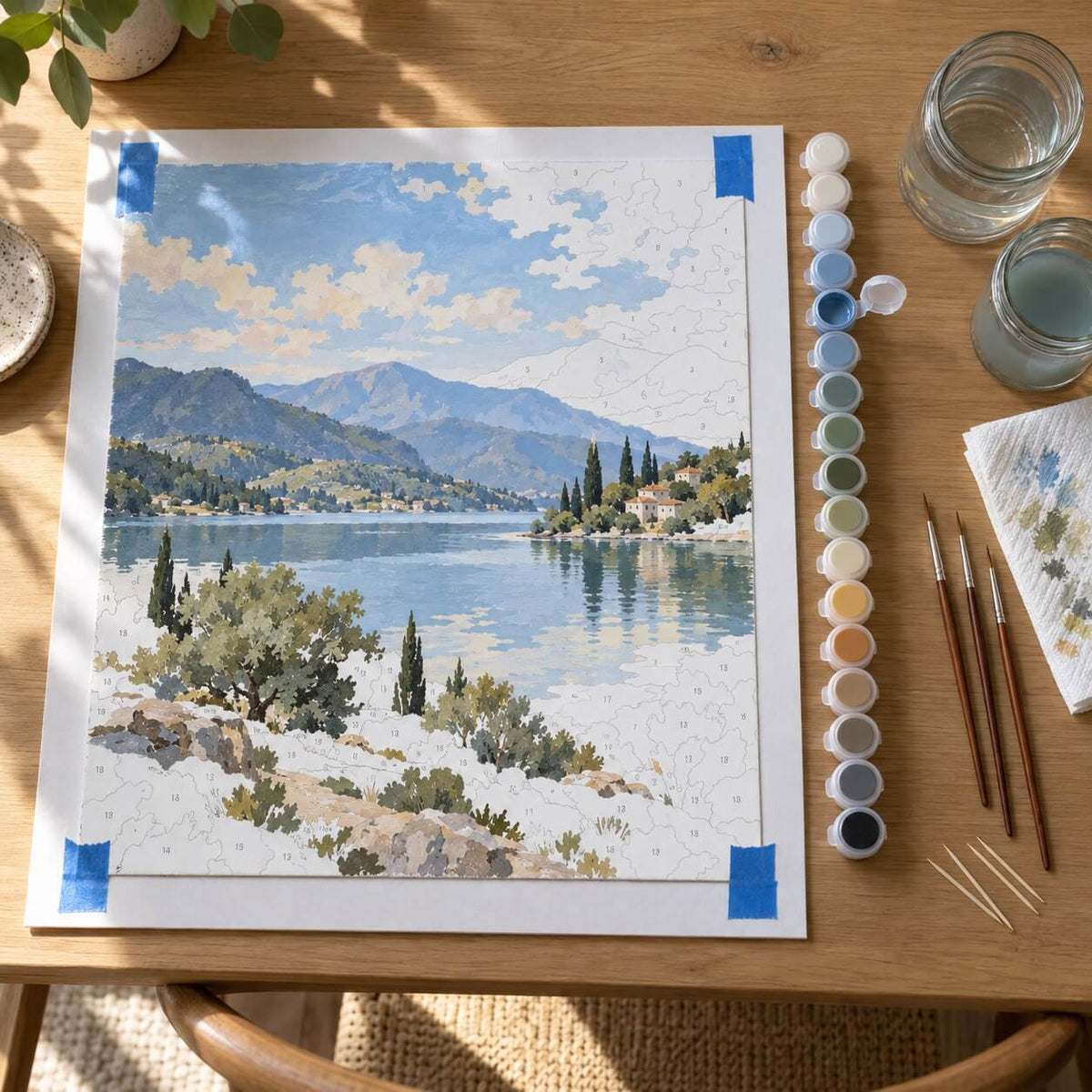
These clear shapes and strong color contrasts also explain why his work is often adapted into paint by numbers kits. Some flower paintings translate into numbered areas more easily than others, however. Thin petals, overlapping leaves and small changes between similar colors can make a design far more detailed than it first appears.

Van Gogh Flower Paintings: Key Facts
- Van Gogh painted more than 35 flower still lifes after moving to Paris in 1886.
- His Paris sunflowers show cut flower heads, while the later Arles series places sunflowers in vases.
- Irises from 1889 shows flowers growing in the garden at Saint-Paul-de-Mausole. It is different from the iris bouquets he painted in 1890.
- Almond Blossom was painted in 1890 as a gift celebrating the birth of his nephew, Vincent Willem.
- Several flower paintings look different today because light-sensitive red pigments have faded over time.
For a wider view of his portraits, landscapes and night scenes, our guide to the most famous Van Gogh paintings places these floral works within his short but rapidly changing career.
Why Van Gogh Painted So Many Flowers in Paris
Van Gogh arrived in Paris in 1886 after working mainly with dark earth colors in the Netherlands. The paintings he saw there introduced him to brighter palettes and newer approaches to placing contrasting colors beside one another. Flowers gave him an affordable subject that could be rearranged and painted repeatedly without hiring a model.
In a letter to the English artist Horace Mann Livens, Van Gogh described painting red poppies, blue cornflowers, roses and yellow chrysanthemums while looking for oppositions such as blue against orange, red against green and yellow against violet. That statement gives the Paris flower paintings a clearer purpose than later claims about hidden symbolism: many were practical color studies.
The change did not happen through color alone. Some bouquets fill almost the entire canvas, while others leave more space around a small vase. Van Gogh also varied the backgrounds, moving between dark grounds, pale walls and strong yellow or blue fields. Repeating the same basic subject let him test how these choices changed the appearance of the flowers.
Paris Sunflowers and Arles Sunflowers Are Different Series
The name Sunflowers is often treated as if it referred to one painting. Van Gogh actually worked on two distinct groups. In Paris in 1887, he painted cut sunflower heads lying on a surface. These works focus on curled petals, seed centers and the changing condition of the flowers rather than on a decorative arrangement.
In Arles in August 1888, he placed sunflowers in simple earthenware vases. He wanted the paintings to help decorate the Yellow House while preparing for Paul Gauguin's arrival. The best-known London version contains fifteen flowers, but the series also includes different arrangements and backgrounds. Van Gogh returned to the subject in early 1889 and made repetitions of earlier compositions.

The Arles paintings are important partly because Van Gogh achieved separation within a narrow yellow palette. The flowers, vase, tabletop and background may look similar from a distance, yet each area uses different mixtures and textures. The recognizable vase and restricted palette also make Sunflowers a frequent subject among Van Gogh paint by numbers kits, although the layered petals remain more detailed than the composition first suggests. Van Gogh later imagined two sunflower canvases displayed on either side of a version of La Berceuse. That documented arrangement is more useful than assigning a broad life-and-death meaning to every sunflower in the series.
Flowers During Van Gogh's Final Year in Saint-Rémy
Van Gogh entered Saint-Paul-de-Mausole in Saint-Rémy in May 1889. One of the first major works he made there was Irises, painted from flowers growing in the institution's garden. The low viewpoint, cropped edges and mass of pointed leaves make it feel different from a conventional vase arrangement. A single pale iris interrupts the blue-purple group and gives the composition a clear focal point.

Near the end of his stay in 1890, he painted four large bouquets: two of irises and two of roses. He used different color relationships across the group, but some of those relationships are less visible now. Red lake pigments used in parts of the flowers and backgrounds faded, changing purples toward blue and pinks toward white. The paintings should therefore not be read only by comparing their present colors.
Almond Blossom, painted in February 1890, had a different purpose. Van Gogh made it for his brother Theo and sister-in-law Jo after the birth of their son, Vincent Willem. The flowering branches are shown against an open blue field, with a cropped composition influenced by Japanese prints. Unlike the bouquets, it is a family gift tied to a specific event.
15 Notable Van Gogh Flower Paintings
-
Vase with Gladioli and Chinese Asters (1886)
Painted in Paris in August or September 1886, this upright bouquet uses red flowers against green leaves and a cool background. The arrangement shows how Van Gogh was testing complementary colors soon after leaving the darker palette of his Dutch period. The painting is held by the Van Gogh Museum in Amsterdam. -
Vase with Poppies, Cornflowers, Peonies and Chrysanthemums (1886)
This large mixed bouquet is one of the most densely packed works from the Paris campaign. Different flower types gave Van Gogh several shapes and strong colors to organize within one composition rather than a single repeated motif. -
Vase with Red and White Carnations on a Yellow Background (1886)
The red and white carnations are set against a warm yellow field instead of a dark neutral background. The close crop and overlapping stems make the bouquet feel larger than the vase holding it. -
Vase with Lilacs, Daisies and Anemones (1887)
Van Gogh combined small white daisies with heavier clusters of lilac and darker anemones. Rather than giving each flower an invented meaning, the painting is better understood as another study in balancing unlike shapes, sizes and colors. -
Sunflowers, Paris Series (1887)
These paintings show cut sunflower heads resting on a surface, not flowers arranged in a vase. Their exposed seed centers and curling petals make them less decorative and more closely observed than the later Arles compositions. -
Oleanders (1888)
Painted in Arles, Oleanders places pink flowers in a majolica jug beside a book. The broad flowers stand against a yellow wall, while the dark tabletop prevents the pale jug from disappearing into the background.
-
Vase with Fifteen Sunflowers (1888)
The version in London's National Gallery is the best-known work from the Arles series. Open flowers, side-facing heads and dry seed centers show different stages within one arrangement. The nearly all-yellow setting depends on small changes in tone rather than a wide range of unrelated colors. -
Vase with Twelve Sunflowers (1888)
Now in Munich's Neue Pinakothek, this version uses a blue-green background that produces a stronger cool-warm contrast with the yellow flowers. It should not be treated as an alternative title for the London painting; it is a separate canvas within the Arles group. -
Irises (1889)
This Getty Museum painting shows irises rooted in the garden rather than cut and placed in a vase. The stems and leaves continue beyond the edges, while one pale flower breaks the repeating field of darker blooms. -
Poppies and Butterflies (1890)
The flowers grow across the canvas without a vase or a distant horizon. Butterflies appear among the stems, and the tight crop turns a small patch of plants into the full subject. The work belongs to the Van Gogh Museum. -
Almond Blossom (1890)
Flowering branches cross a turquoise-blue background with no visible ground line. Van Gogh painted it for his newborn nephew, making its connection with new life specific and documented rather than a general symbolic guess.
-
Irises (1890, Metropolitan Museum of Art)
This late bouquet is one of the four large flower still lifes Van Gogh completed shortly before leaving Saint-Rémy. The flowers are placed in a vase and should not be confused with the 1889 garden scene at the Getty. -
Roses (1890)
The Metropolitan Museum of Art's bouquet once contained stronger pinks than viewers see today. Fading red pigment changed the balance between the roses and their green surroundings, which is an important reminder that the current palette is not fully original. -
Vase with Irises Against a Yellow Background (1890)
The yellow field pushes the cool flowers forward and makes the green stems easier to separate. This Van Gogh Museum canvas is the second major iris bouquet from the group painted at the end of the Saint-Rémy period.
-
Roses (also known as Vase with Pink Roses), 1890
Painted shortly before Van Gogh left Saint-Rémy, this wide bouquet spreads laterally across a pale green background. The National Gallery of Art in Washington lists the painting as Roses, while Vase with Pink Roses is also widely used. Its rounded roses and flowing leaves give it a softer structure than the pointed iris arrangements.
How Van Gogh's Flower Paintings Changed
The development is easier to see when the works are grouped by place rather than by flower type:
- Paris, 1886–1887: mixed bouquets and cut flowers served as repeated color exercises. The subjects are often crowded, with several species competing for space.
- Arles, 1888–1889: Van Gogh simplified the arrangements and used larger, more recognizable forms. The sunflower vases rely on a restricted palette and a direct frontal view.
- Saint-Rémy, 1889–1890: he alternated between flowers growing outdoors, large vase studies and flowering branches. Cropping and the influence of Japanese prints are especially clear in Irises and Almond Blossom.
This sequence also corrects a common shortcut. Van Gogh did not paint every flower as a direct record of his psychological state. His letters document practical work with color, plans for decorating rooms and a family gift. Those explanations are more reliable than assigning the same emotional story to every bouquet.
Which Van Gogh Flower Paintings Work Best as Paint by Numbers?
When we review flower paintings for numbered conversion, the main difficulty is not simply the number of paint colors. Narrow petals, overlapping stems and areas with several closely related shades determine whether the design remains readable on canvas.
More approachable
Almond Blossom has a large open background and a clear branch structure. The small blossoms still require care, but there are fewer crowded clusters than in the Paris bouquets. Still Life: Vase with Pink Roses also has broader flower shapes, although neighboring pale tones can be easy to confuse.
Intermediate
Sunflowers has a strong central subject and is easy to recognize while painting. The seed heads and layers of narrow petals add more sections than the simple yellow palette suggests. A Sunflowers paint by numbers version therefore sits between a basic floral design and a highly detailed one.
More detailed
Irises contains many pointed leaves, crossed stems and small changes between blue, violet and green. The mixed Paris bouquets are also demanding because several flower types overlap. A larger canvas gives these narrow areas more room and reduces the need to merge neighboring details.
Frequently Asked Questions
What is Van Gogh's most famous flower painting?
Sunflowers is his best-known floral subject. The name covers several paintings, but the vase with fifteen sunflowers at the National Gallery in London is the version most widely reproduced.
How many Sunflowers paintings did Van Gogh make?
There is no single Sunflowers canvas. Van Gogh painted cut sunflower heads in Paris in 1887, a separate group of sunflower vases in Arles in 1888 and repetitions of some Arles compositions in 1889. Counts vary depending on whether lost work and repeated versions are included.
Did Van Gogh paint more than one version of Irises?
Yes. The famous 1889 Irises at the Getty Museum shows flowers growing in a garden. In 1890, Van Gogh also painted two large iris bouquets in vases. These are separate compositions, not alternate names for the Getty painting.
What did flowers symbolize in Van Gogh's work?
There is no single meaning that applies to all of them. The Paris bouquets were closely connected with his study of color. The Arles sunflowers were associated with decorating the Yellow House and Gauguin's visit. Almond Blossom marked the birth of Van Gogh's nephew. Meanings such as hope, passion or renewal should not be assigned to every flower without evidence from the work's context.
Where can you see Van Gogh's flower paintings?
Major examples are spread across several museums. The Van Gogh Museum holds Almond Blossom, Poppies and Butterflies and one of the iris bouquets. London's National Gallery has the vase with fifteen sunflowers, the Getty Museum has the 1889 garden Irises, and the Metropolitan Museum of Art holds late bouquets of irises and roses.
From Paris Color Studies to Almond Blossom
Van Gogh's flower paintings are most useful when viewed as groups tied to specific places and purposes. The Paris bouquets show him working through new color relationships. The Arles sunflowers connect with his plans for the Yellow House, while the late irises, roses and almond branches belong to distinct projects in Saint-Rémy. Separating those contexts produces a clearer account than treating every flower as a symbol of the same emotion.