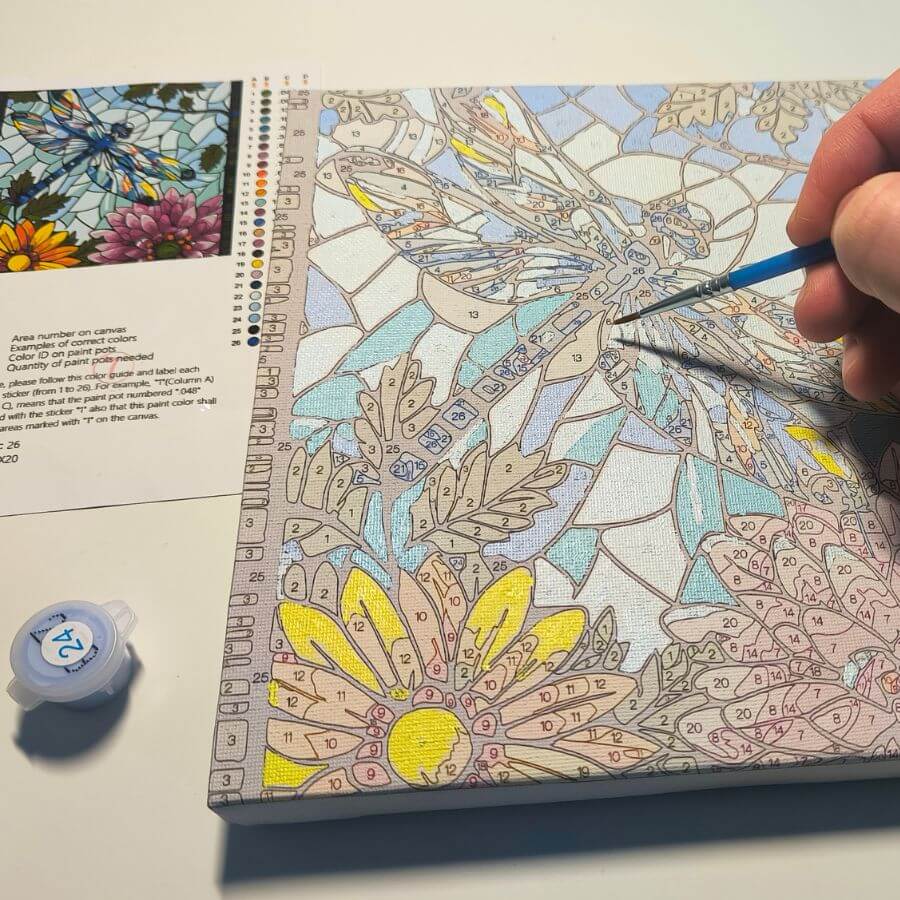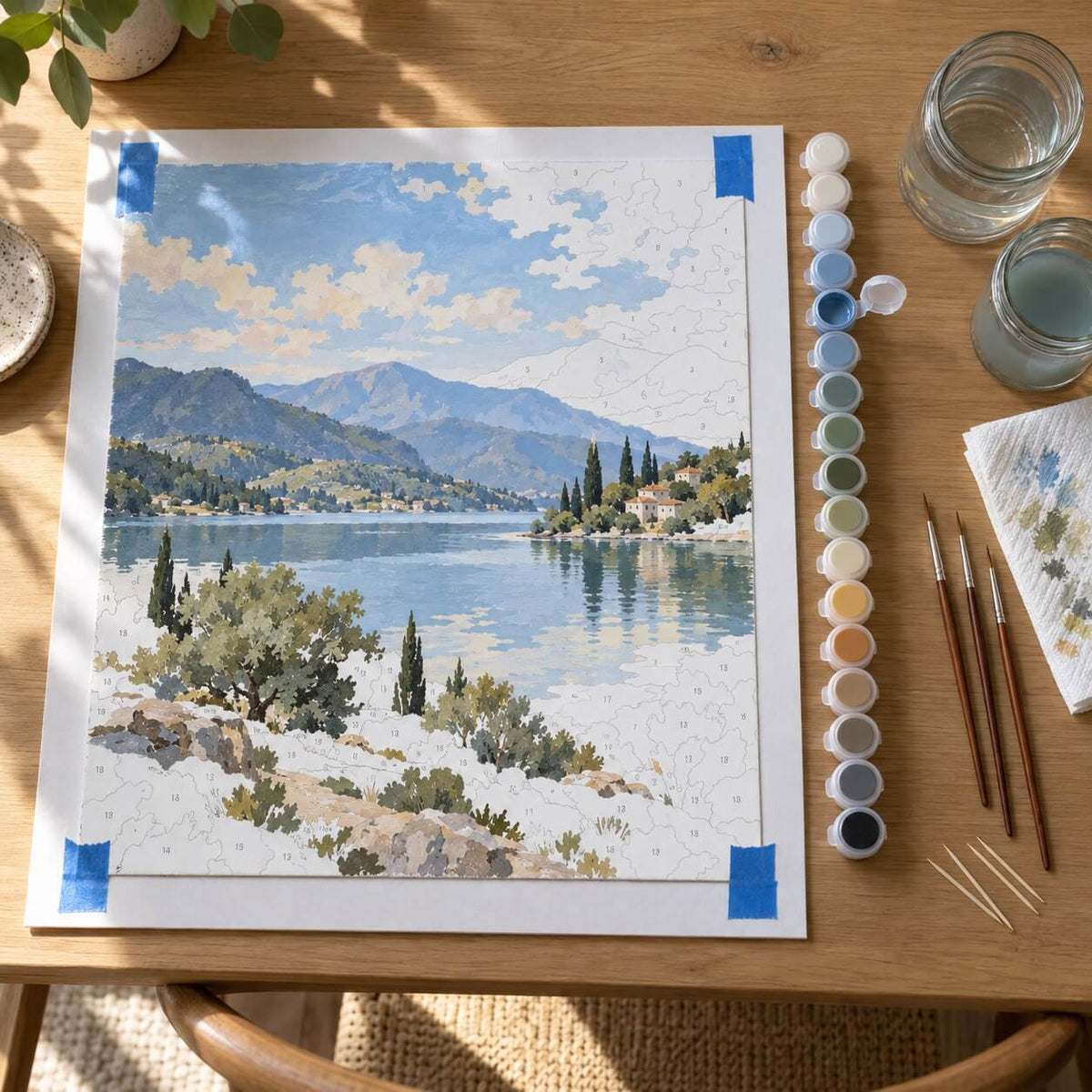

Most paint by numbers kits for adults include three brushes, which is enough to complete a standard canvas. An additional brush can still make tiny sections easier to fill, keep edges cleaner and reduce visible streaks. You do not need a large set—a precise round brush and a small flat brush will cover nearly every part of a painting. To see where brush choice fits into the whole process, read how to paint by numbers.
Best Brushes for Paint by Numbers: Quick Answer
For a simple setup that works with most paint by numbers kits, use:
- Size 00 or 0 pointed round brush for tiny sections, narrow edges and printed lines.
- Size 1 round brush for most standard numbered areas.
- Small flat brush for backgrounds and larger blocks of one color.
Brush numbers are not completely standardized. A size 0 from one manufacturer can be wider than a size 1 from another, so check the actual point instead of relying only on the number. When the bristles are damp and shaped, the point should be slightly narrower than the area you want to paint.
What Size Brush Should You Use?
The best brush size depends on the width and shape of each numbered section. Using the largest brush that just fits may seem faster, but its bristles spread when pressed against the canvas. A slightly smaller brush gives you more room to follow the outline without pushing paint into the next color.
Size 00 or 0 for Small Details
A pointed round brush in size 00 or 0 works well around faces, eyes, flower centers, thin branches and other narrow sections. The point matters more than the printed size. If the bristles separate as soon as they touch the canvas, the brush will not produce a clean edge.
For isolated dots and very small cells, a short-bristled spotter brush provides more control than a long, flexible tip. A liner brush can help with whiskers, branches and other long, narrow shapes, although it is not essential for most kits.
For canvases with faces, fur or numerous tiny sections, a miniature detailing brush set offers shorter and finer tips than the standard brushes supplied with most kits. Avoid cutting bristles from a larger brush, as trimming often leaves an uneven point that separates under pressure.

Size 1 for Standard Sections
A size 1 pointed round is the most useful general-purpose brush. It holds more paint than a very fine detail brush but remains narrow enough for most numbered areas. Changing the pressure lets you use the tip for an edge and the wider part of the bristles for filling the center.
If you want to add only one brush to the three supplied with your kit, a good size 0 or 1 pointed round will be useful across more sections than a highly specialized brush.
Small Flat Brushes for Large Areas
A small flat brush is useful for skies, walls, water and other broad sections. Choose one that is narrower than the area being painted. Apply light pressure and move in a consistent direction to keep the layer even.
A large flat brush is rarely necessary. Paint by numbers backgrounds often have irregular boundaries, so an oversized brush may save time in the center but create extra correction work around the edges.
What Makes a Good Paint by Numbers Brush?
A useful brush should form a clean point when damp and return to its shape after light pressure. Check these four features when comparing brushes:
- Point retention: The bristles should close into one tip instead of separating into several ends.
- Spring: The brush should bend slightly and then return to its original shape.
- Secure ferrule: The metal part should not move or release loose bristles into wet paint.
- Comfortable handle: A short handle is usually easier to control when you work close to the canvas.
Synthetic nylon or taklon bristles are the most practical choice for the acrylic paint supplied in paint by numbers kits. They form a smooth point, are easy to rinse and provide better control in small sections than coarse natural hog bristles.
Most inexpensive kit brushes are synthetic too. A better brush stands out because it uses finer bristles, returns to its original shape and keeps a clean point after repeated rinsing.

How to Avoid Streaks and Paint Outside the Lines
Brush size is only one part of clean coverage. Before loading the brush, dampen the bristles and remove the excess water. Pick up paint with the front third of the brush rather than coating the bristles up to the ferrule.
If paint runs into a neighboring section, the brush is probably overloaded, too wide or holding too much water. Remove some paint on the edge of the pot and fill the area with light pressure. Let the bristles move across the canvas instead of pressing them flat.
For a large section, two controlled coats usually produce a cleaner result than one heavy coat. Allow the first layer to dry before adding the second. When a pale color does not hide the outline completely, a fine pointed brush makes it easier to cover the printed lines and numbers without applying a heavy layer across the entire section.
How to Keep the Brush Tip Sharp
Acrylic paint can dry between the bristles while you are still working. Rinse the brush regularly instead of waiting until you change to a different color. Pay particular attention to paint collecting where the bristles enter the metal ferrule, since dried paint in this area causes the tip to spread.
After painting:
- Rinse the brush in lukewarm water.
- Work a small amount of mild soap through the bristles if paint remains.
- Rinse again without pulling or twisting the bristles.
- Shape the point gently with your fingers.
- Leave the brush flat to dry.
Do not leave brushes standing in a water cup. The tip can bend against the bottom, while prolonged soaking may loosen the ferrule or damage the handle.
When Should You Replace a Brush?
A brush does not need replacing just because the tip looks untidy while dry. Dampen it, reshape the point and test it on a spare surface first. Replace it when the bristles continue to split, curl to one side, shed into the paint or no longer return to a point.
A split tip is often caused by dried acrylic near the ferrule rather than ordinary wear at the end of the bristles. Once the paint has hardened deep inside the brush, reshaping the tip may no longer correct the problem.
Are the Brushes Included in a Kit Enough?
Every kit from Painting by Numbers Shop includes three brushes suitable for completing the canvas. For a first project or a design with larger sections, you may not need anything else.
In our three-brush sets, the smallest round brush handles narrow edges, corners and tiny numbered sections. Because the same tip is used across so much of a detailed canvas, it tends to show wear before the two larger brushes. Cleaning it before paint dries near the ferrule helps it keep its shape longer.
An additional detail brush is useful when the supplied tip no longer stays sharp or the design contains numerous small sections. Other brush sizes and painting tools are available in our paint by numbers accessories category.